
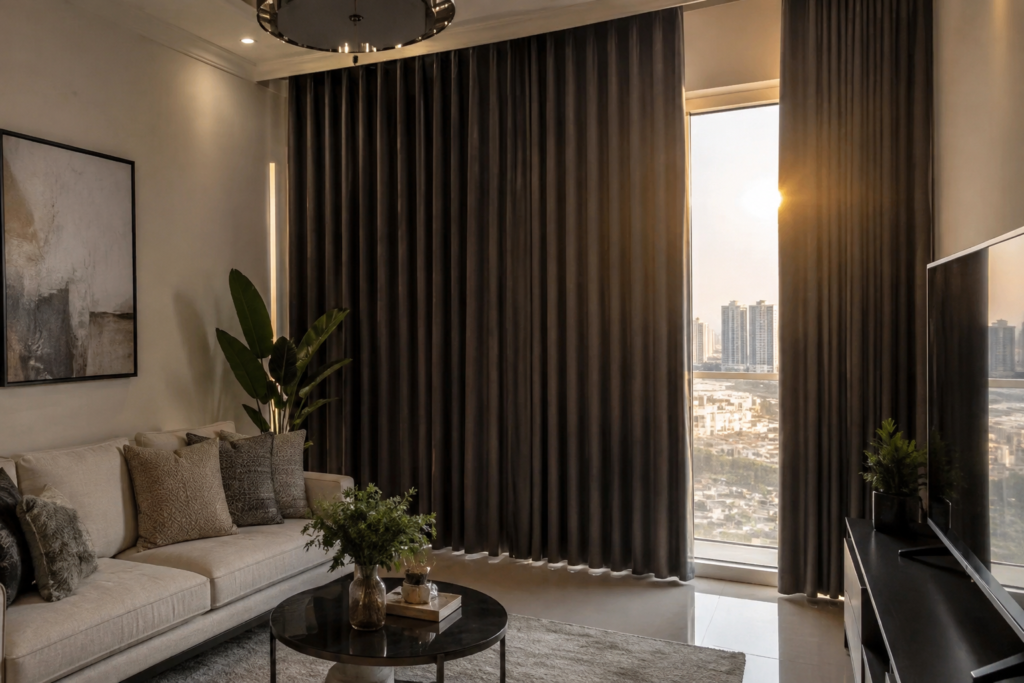
I still remember the first time a client in Al Barsha told me her AC was running nonstop and her bedroom was still warm at 6pm. We checked everything the unit, the thermostat, even the door seals. Turned out the real culprit was hanging right there in front of us: a pair of thin, pretty-but-useless curtains letting the entire afternoon sun pour straight through the glass. That’s the moment I stopped thinking of curtains as decoration and started treating them as part of the cooling system. If you live here, blackout curtains UAE homeowners are increasingly switching to aren’t a luxury add-on anymore they’re closer to a basic summer survival tool, right up there with a working AC unit. Let me walk you through why, and more importantly, how to actually pick ones that work instead of just looking nice.
Dubai Heat Doesn’t Play Fair
You already know this if you’ve lived through even one August here, but it’s worth saying plainly: this city’s summer isn’t like most places. From June through September, you’re routinely looking at 45°C-plus in the afternoon, and glass windows sitting in direct sun get hotter than the air around them. It’s not a heatwave that passes in a week. It just… sits there. For months.
And here’s the thing nobody explains clearly enough that heat doesn’t politely stay outside your window. Thin curtains, sheer ones, anything without real substance to it, let solar heat pass right through like the fabric isn’t even there. Your AC ends up fighting a battle it didn’t need to fight, cycling on and off constantly just to keep up. Cooling already eats up a massive chunk of household electricity in the UAE we’re talking more than half of a typical bill during peak months. So if your electricity bill jumps every July and you can’t figure out why, take a hard look at your windows before you blame the AC unit.
What Actually Makes a Curtain “Blackout”
Here’s where I see people get burned, honestly. They walk into a shop, see a dark, heavy-looking fabric, assume it’s blackout, and go home happy only to find their room’s still stuffy by 3pm. Color has almost nothing to do with it.
What matters is the construction. A real blackout curtain has a tightly woven, usually multi-layered fabric that blocks light and radiant heat, not just one or the other. A single-layer curtain in a dark shade will dim the room fine but won’t touch the actual temperature. That’s a different job entirely, and a lot of buyers don’t realize it until they’ve already spent the money.
The lining is really where the magic happens. You want a thermal backing, and ideally one with a reflective coating facing the window, because that’s what bounces the heat back outward instead of soaking it up like a sponge. And don’t skimp on coverage curtains that stop short of the window frame, or hang a bit too narrow, leave gaps where heat sneaks straight in no matter how good the fabric itself is. Floor-length, slightly oversized panels beat short, tight ones every time.
Quick way to test this yourself before buying: hold the fabric up against a bright light. Can you still see shapes through it, or a strong glow? If yes, it’s not doing what it’s supposed to, no matter what the label says.
Okay, But What Do You Actually Get Out of This
People tend to think blackout curtains are just for sleeping in a pitch-dark room, and sure, that’s part of it. But that’s honestly the smaller piece of the puzzle.
The bigger win is what happens to your cooling bill. Less heat getting in means your AC isn’t working as hard, which shows up directly on your electricity bill not dramatically overnight, but month over month it adds up in a way most people notice within a billing cycle or two. Sleep improves too, and not in some vague wellness-blog way a cooler, darker room genuinely helps you sleep deeper, which matters here because Dubai nights don’t really cool down much even at 2am. Your furniture benefits as well. Sun-fading is real, and it’s sneaky you don’t notice your sofa or your wooden table losing color until it’s already happened. A decent lining slows that down considerably. And as a bonus nobody asks about but everyone appreciates once they have it: the thicker fabric muffles outside noise too, which is nice if you’re anywhere near a main road.
I’ve talked to a handful of interior consultants around Dubai over the years, and they all say some version of the same thing this is one of the rare home upgrades where you actually feel the difference within days, not months.
Blackout vs. White vs. Custom — Pick Based on Your Windows, Not Trends
This is where people usually get stuck, so let’s just sort it out.
White curtains have their appeal they reflect a decent amount of sunlight just by being light-colored, and they look bright and airy. Fair enough. But here’s the catch most people miss: unless they’re specifically built with a blackout lining underneath, they’re not really cutting glare or heat the way you’d hope. They’re doing a partial job and calling it a full one.
Custom curtains, on the other hand, let you have it both ways. You pick whatever outer fabric matches your room light, patterned, whatever you like and pair it with a proper thermal blackout lining underneath where it actually counts. Yes, it costs more than grabbing something off the shelf. But for a west-facing bedroom that takes the brunt of the afternoon sun, it’s money well spent, not a splurge.
And if you’re reading this from Abu Dhabi instead of Dubai nothing changes for you here. Same sun, same heat, same fabric requirements. The emirate doesn’t matter; the physics does.
Mistakes I See Way Too Often
A few things worth flagging before you spend your money:
Don’t judge a curtain by its color. Dark doesn’t automatically mean blackout check what’s actually lining the fabric.
Don’t go cheap on width. A curtain that barely covers the window frame is basically inviting heat in around the edges.
Don’t skip measuring. Most custom suppliers measure for free, and skipping this step is how people end up with curtains that pool awkwardly on the floor or leave a gap at the top.
Don’t take “energy-saving” on a label at face value. Ask directly what the lining is made of. Vague marketing language usually means there isn’t much substance behind it.
Bottom Line
Your curtains are quietly doing a lot more work than you probably give them credit for good or bad. A proper set of blackout curtains can genuinely lower your cooling costs, protect your furniture from years of sun damage, and get you sleeping better even when it’s still uncomfortably warm outside at midnight. Personally, I’d rather spend a little more once on decent thermal lining than keep cranking the AC lower every summer and watching the bill climb anyway. If your bedroom’s been fighting you every June, maybe it’s time to stop blaming the AC and take a proper look at what’s hanging in front of your windows. Got questions about what’ll actually work for your space? Ask away in the comments happy to help you figure it out.
A Few Questions People Always Ask
Does this stuff actually lower the temperature, or just block light?
It genuinely lowers heat gain, not just brightness assuming it’s properly thermal-lined. A dark curtain with no lining is really just blocking light.
Are the ones sold locally different from what you’d find elsewhere?
Not in how they’re built, but suppliers here tend to lean toward heavier, more UV-resistant fabric, since regular sun exposure this intense isn’t the norm everywhere.
Is custom really worth the extra cost over something ready-made?
If your windows are an odd size or the room takes serious afternoon sun, yes the fit and performance difference is noticeable, not marginal.
Can I just get white curtains instead and skip the blackout ones?
You can, but you’re trading full heat and glare control for a lighter look. Fine for some rooms, not ideal for a bedroom that needs real cooling.
How long before I need to replace them?
Decent quality, UV-resistant fabric usually holds up for five to seven years before fading or wear really sets in.